
Knowledge-Assisted Visual Analytics Methods for Time-Oriented Data. New methods will take advantage of explicit expert knowledge in the Visual Analytics process of data.

The visualization of complex data
Analytical reasoning for real world problem solving involves large volumes of uncertain, complex, and often conflicting data that analysts need to make sense of. In this context, time-oriented data is commonplace and plays a special role. Due to the distinct characteristics of time, appropriate methods for exploration and analysis are needed.
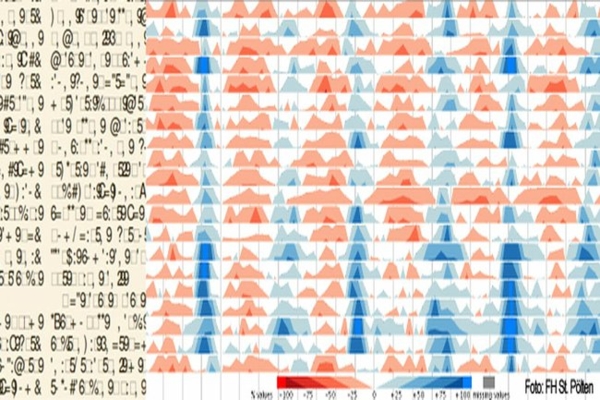
For example when displaying lab results in electronic patient records this could mean to show expected value ranges for healthy patients depending on their context such as gender or age. For representing stock price data, the time axis would suppress weekends and bank holidays to avoid a distorted representation of value change. Solutions like these might be achieved by creating specialized applications for each domain and analysis problem at hand. However, this would cause lots of effort and make maintenance and reuse difficult.
To avoid this, Visual Analytics methods which adapt to different contexts and combine interactive visual interfaces with automated analysis methods will be designed. Even though computers have the ability to recognize and visualize patterns in data, they often lack the background knowledge to interpret said data. Therefore, human analysts and their expert knowledge are essential to the process of data analysis.
How to take advantage of human expert’s knowledge
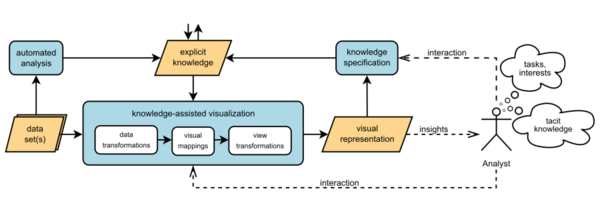
Ideally, a Visual Analytics environment would adapt itself to the user’s context and domain specifics of the data to analyse by having access to human knowledge. The basic research project KAVA-Time explores how to take advantage of explicit expert knowledge in the Visual Analytics process to make analytical reasoning more effective and efficient. The project team develops and evaluates knowledge specification methods as well as knowledge-assisted visualization and interaction methods for time-oriented data. This encompasses two main objectives:
- to capture analysts' domain knowledge and explorative interests
- to take advantage of the explicit knowledge in interaction and visualization methods.The newly integrated specification methods will not only take into account externally given knowledge but also the reuse and sharing of these specifications. Interactive Visual Analytics methods will allow intuitive and direct refinement of explicit knowledge by analysts.
Insights gained by man and machine
Tackling this issue will give rise to more effective environments for gaining insights – the possibility to specify, model, and make use of auxiliary information about data and domain specifics in addition to the raw data, will help to better select, tailor, and adjust appropriate methods for visual representation, interaction, and automated analysis.

Publications
Press coverage
Ordnung und Wissen in die Datenflut bringen
04/08/2019Eine Forschungsgruppe von der Fachhochschule St. Pölten hat im Rahmen eines vom Wissenschaftsfonds FWF finanzierten Projekts eine vielseitig einsetzbare Umgebung zur Datenvisualisierung entwickelt, in der auf einfache Weise Expertenwissen integriert werden kann.
Medium: scilog
Vorbereiten auf die digitale Welt
11/16/2016Medium: Der Standard
Wissenschaft und Forschung in Niederösterreich
11/01/2016Medium: UNIVERSUM Magazin
Big Data – und welche Chancen Daten bieten
06/10/2016Medium: Die Presse
"Landkarte und Kompass für den Datendschungel"
11/30/2016Medium: Der Standard
Autor: Alois Pumhösel
Teamwork zwischen Gehirn und Prozessor
06/02/2014Medium: Der Standard
Author: Pumhösel Alois
Visual-Analytics-Systeme sollen ihren Benutzern durch eine anschauliche Aufbereitung mehr Übersicht über Datenmaterial geben. Niederösterreichische Forscher entwickeln eine Plattform, in der automatische und menschliche Analyse Hand in Hand gehen.
- Fachbereich Informatik und Informationswissenschaft, Universität Konstanz
- information engineering group, TU Vienna
- Datenanalyse und Visualisierung, Universität Konstanz
- Institut für Informatik, Universität Rostock