
Introduction
In this project, we are following the USTP working strand on computationally enhanced analysis of manuscripts using computer vision and advanced visual interfaces. We have worked on scribe identification in medieval manuscripts (URL: https://research.ustp.at/en/projects/scribe-id-ai) and are currently working on the analysis of medieval penwork (URL: https://research.ustp.at/en/projects/peuafleu-analysis-of-fleuronnee).
The subject of investigation in this project is hand-copied opera scores. Markus Seidl has teamed up with Martin Eybl (https://www.mdw.ac.at/imi/martin_eybl/), who is a leading expert on this topic.
Background
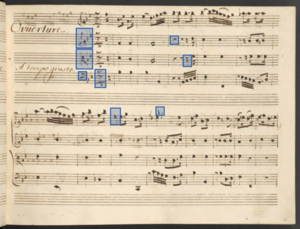
Many works by Haydn, Gluck, and other composers have not survived in their original manuscripts but only as copies, often produced by professional copyists around the time of performance. Because many of these copies are undated, their exact time of origin remains uncertain. More than thirty years ago, the Hungarian musicologist László Somfai therefore called for a catalogue of “Viennese copyists from about 1750 to 1770,” to be developed through a “systematic examination” of Viennese opera scores. For his catalogue, Somfai proposed a special form (a Formularkartei) to record the distinguishing features of individual notation. However, he considered the systematic study of watermarks unrealistic, given the “gigantic amount of data.” With recent developments in machine learning, however, the vision he articulated had become a tangible goal.
Project Content
A database developed in two previous projects already makes it possible to date music manuscripts written by Viennese professional copyists. It also helps attribute undated manuscripts to specific copyists and determine whether they originated in Vienna. So far, our work has mainly focused on categorizing compositions created in urban contexts, whereas in the current project we turn the spotlight on music manuscripts produced at the Viennese royal court.
For the period and material under study here, systematic research is still lacking. We aim to fill this gap by incorporating digital visualization and image-processing techniques into our work, building on the promising results already achieved through the integration of musicology and digital humanities. In particular, we apply machine-learning methods to musicological research in a novel way, with the goal of identifying copyists and analysing their notation.
Aims and Important Steps
The project pursues three main goals:
- To apply computer vision and machine learning techniques in order to distinguish and identify copyists of musical compositions.
- To establish a basis for dating manuscripts produced at the royal court as well as other manuscripts of Viennese provenance. Previous research has shown that professional copyists frequently changed paper types, which provides useful clues for dating. However, combining several indicators will increase precision. In this project, for instance, we examine patterns of collaboration among copyists in tandem with the types of paper they used.
- To analyze the material structure of the music manuscripts and the distribution of scribes and paper, thereby deepening our understanding of manuscript production at the Viennese court. This includes studying collaborations among copyists, the kinds of paper they used, patterns of staff ruling, and bookbinding practices.
Innovation and Outcomes
Inspired by computational approaches to writer recognition and optical music recognition (OMR), we leverage computer vision and machine learning to identify music copyists. This allows us to recognize copyists and categorize their works more efficiently. Moreover, we can statistically examine variations in writing style and develop metrics that provide insight into a copyist’s experience and competence. Overall, we assume that these methods will increase both the efficiency and accuracy of our analyses.
Partner

Funding

Image: Giuseppe Porsile / Giovanni Claudio Pasquini, Scipione Affricano, il Maggiore: Festa di camera per musica … Soli und Chor, manuscript score, 1730. Source: ÖNB Digital / Österreichische Nationalbibliothek, https://onb.digital/result/131BADBF. Licence: as indicated on ÖNB Digital.
You want to know more. Feel free to ask.

- Universität für Musik und darstellende Kunst Wien (lead)