
Simulating and visualizing the aging of oil paintings in virtual reality.
Project Content and Aims
Extensive research in art conservation has documented how environmental factors (such as temperature, relative humidity, and UV radiation) significantly impact the condition and longevity of oil paintings on canvas. This project aims to develop a virtual reality (VR)-based framework for simulating the aging and degradation processes of such paintings. The framework will integrate interactive visualizations of material changes to offer a dynamic, real-time representation of cumulative environmental effects on paintings. By combining procedural texturing (algorithmic generation of textures using mathematical principles), physically based rendering (PBR) (a rendering approach that simulates how light interacts with materials based on physical laws), and GPU-accelerated algorithms, this framework balances computational efficiency with visual realism. The project addresses three critical research gaps:
- the incorporation of empirical data from published conservation studies, archival records, and imaging-based examinations into real-time simulations of environmentally driven degradation phenomena
- holistic visualization of simultaneous aging effects in VR
- the development of VR-based tools for user studies and decision-making in cultural heritage, particularly regarding storage, display, and preventive conservation strategies
Methods
A multidisciplinary methodology is employed, spanning a thorough literature review, the acquisition and analysis of conservation data from published studies and archival documentation, digital imaging, 3D reconstruction and computational modelling of the aging processes and material degradation in oil paintings on canvas. The resulting framework is integrated into a VR environment, with added functionality to support conservation workflows and enable empirical user studies. These studies will investigate how visual degradation affects viewer attention and perception: eye-tracking will be used to record gaze patterns and fixation durations to identify if and which damaged areas attract attention, while questionnaires will gather subjective feedback on aesthetic perception and emotional responses.
Result and Impact
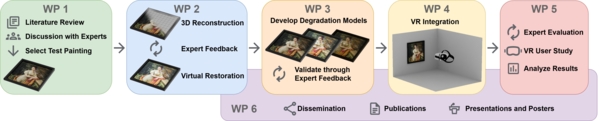
The framework developed here will serve as a tool for conservators, curators, and stakeholders, enabling preventive conservation strategies. It also supports empirical user studies that investigate how visual degradation affects aesthetic perception and emotional responses to artworks. These studies provide insights not only for conservation decision-making but also for enhancing public engagement: by interacting with the VR environment, audiences can explore and experience the aging processes of paintings firsthand, making the complexities of art preservation more tangible and understandable. While the immediate focus of the proposed dissertation is on visualizing the deterioration of cultural heritage, the methodologies and findings will have considerable potential for applications across various other areas such as education, healthcare and medicine, entertainment, or economics.
Partners



Funding
The content does not necessarily represent the view of the state of Lower Austria or the funding agency. Neither the state of Lower Austria nor the funding agency can therefore be held responsible for the content.
You want to know more. Feel free to ask.

Media Creation Research Group
Institute of Creative\Media/Technologies
Department of Media and Digital Technologies
Dr. Hanna Brinkmann (Universität für Weiterbildung Krems)
Univ.-Prof. Dr. Anja Grebe (Universität für Weiterbildung Krems)
Mag. Theresa Feilacher (Universität für Weiterbildung Krems)
Mag. Eleonora Weixelbaumer (Landessammlungen Niederösterreich)
Mag. Franziska Marinovic
- UWK Universität für Weiterbildung Krems
- Landessammlungen Niederösterreich
- TU Technische Universität Wien